

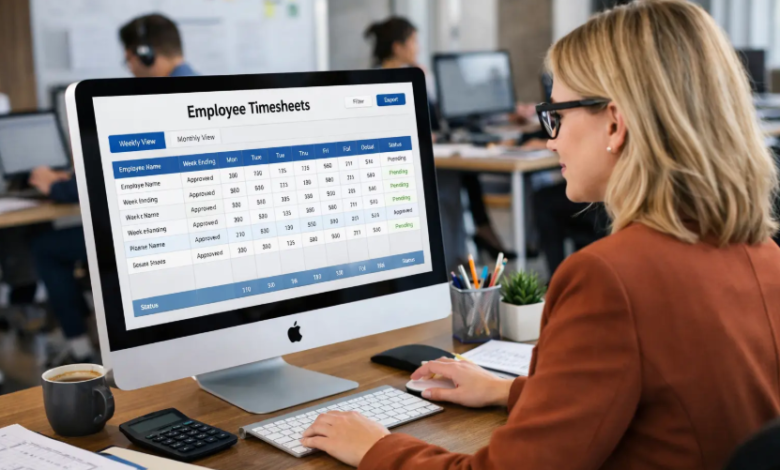
Recording hours worked is no longer enough in today’s ever-changing job market, and more recently, with remote work and hybrid teams. Progressive managers are able to transform raw time data into actionable insights that lead to smarter decision-making, more equitable workloads, and increased profitability. An effective timesheet report indicates areas of improvement and empowers leaders to make informed decisions for optimization of daily tasks versus long-term projects.
Controlio’s Timesheet Reports feature showcases the power of automated time tracking combined with customizable perspectives around employee performance and project outcomes. Controlio helps your team replace basic time logs and gain the visibility needed while minimizing micromanaging.
What Sets Timesheet Reports Apart From Traditional Timesheet Reports
The times of error-filled, forgotten, and manual spreadsheets are long gone. 2026 is shaping up to be the year of timesheet reporting and will deliver the velocity and accuracy of hours worked broken down by billable and non-billable time and employee utilization. With these reports, managers are able to identify and react to the patterns of the team early on so that they are able to make the needed adjustments to eliminate reoccurring bottlenecks and effectively inventory and utilize the skills of the team. Accurate and on-time payroll and client billing are the cherries on the cake. For businesses that operate on a project basis such as agencies and other organizations that are scaling their operations, the reports transform time from an operational cost to a strategic asset.
Essential Functions of Timesheet Reports
The leading platforms go beyond basic hours and offer better capability. Focus on platforms that offer automated time capture, time visualization, granular time spent per user, time spent per project, time spent per task, and time spent per application. Displayed via a heatmap, chart, or similar visualization.
The core functions are:
- Granular admin controls, including project and task categorization, employee grouping and subgrouping, and department and client categorization.
- Multiple time frame views, including daily, weekly, and monthly views, for each unique unit of analysis.
- Multiple time frame views, including daily, weekly, and monthly, for each unit of analysis.
- Exportable time frame views for each unique unit of analysis, including CSV, Excel, and PDF formats.
- Tables/tabs that account for and differentiate idle/worked time.
- Integrated systems for project/work management, payroll, and communication platforms.
Less admin work and better reporting.
The best reporting teams maximize the power of time tracking.
Begin setting the expectation for tracking from day one. Create a clear specification on project/task/break categorization.
The absence of labels results in reports that are less reliable and less clear. It benefits everyone when reports are clear without the confusion of vague labels.
Rather than waiting for the month-end reports, reviews should become a regular part of the workflow. Reviews that happen on a weekly basis are able to catch most of the issues and resolve them before they become serious problems. Problems caused by lack of work in some positions, or work in excess in others, are resolved before they affect the overall flow of the project.
Data should be used as a basis for any discussion regarding performance. Objective and fair standards in the reviews reduce the risk of bias and trust. When employees can see objective standards in a review, they are able to gain a better understanding of the goals and objectives of the company and how their work fits in.
Analyzing projects over time should be done as the overall results are improved when better goals are set and tasks are divided appropriately. Smarter use of available resources increases the overall profit.
The use of data can help to boost self-improvement in teams. In situations where team members are able to view their own data, they often perform better, focus less on tasks that are not relevant to the project, and be more accountable more organically.
Surveillance and employee resistance go hand in hand in the time sheet issue unless the time sheet issue knowledge is distributed and employees know how it will make their lives easier by helping to control the workload, indicate whether or not the employees are being appropriately recognized for their work, and determine whether or not they will be able to help the employees move onward to their future goals.
To ensure the best adoption, get the team involved with the setup and focus on constructive uses versus punitive uses.
Q: How often do I need to review the timesheet reports to see improvement? Consistent weekly review reports show chronic issues and trends, while monthly reports tend to show more strategic things like the systemic issues and the overall structure of the trend. Combine weekly and monthly reports to find the best structure of the trend without overwhelming the team.
Q: Can the timesheet reports be used for budgeting projects and billing clients? Yes, of course. Timely reports and detailed breakdowns for billable hours will reduce lost revenue, improve estimation for the subsequent works, and provide documented reports for the clients to improve trust and justify the billing.
See also: Business Trip Planning: How Professionals Prepare for Work Travel
Securing Team Buy-In
Resistance originates primarily from concerns about privacy and workload. Alleviate this concern by selecting user-friendly software that prioritizes privacy and requires minimal manual work. Select a small pilot group to quickly capture feedback, improve workflow, and demonstrate visible “quick wins” with faster invoicing or lighter manual work. Publicly celebrate wins to ensure the team understands the importance of the data.
The team will develop a certain level of comfort with ongoing training. They will appreciate integrating the reports into their existing workflow, such as linking reports to their project dashboards.
Conclusion: Use the Collected Data from Timesheets as an Asset
The goal of understanding the reports is not to micromanage the employees, but rather to develop a better understanding of the patterns of their work to build smarter and more sustainable teams.
By 2026, businesses that view time data as a growth opportunity will likely outperform their competitors who rely on estimation or antiquated processes. The time and effort required to gather payroll data are eliminated along with the risk of guesswork related to payroll; time reporting reveals efficiencies and imbalances that may lead to burnout and supports realignment to what is most critical to the business.
When beginning this process, it is recommended that you select a maximum of two out of the ten choices to evaluate the full impact of time reporting on the function that you are closing down. Regardless of whether you are leading a scaling agency, managing dispersed talent, or expanding the business, time reporting will provide you with the clarity you need, improve your team’s morale, and enhance your bottom line. Start using the data now; the secret is out. Are you prepared to gain access to the value it can provide? Increased productivity, profitability, and the ability to work more efficiently will be a result of your efforts.